Spray Painting Kitchen Cabinets vs Brush and Roller: Why the Finish Isn't Close
Run your hand across a factory cabinet door. Smooth, hard, no texture at all. Now run it across a door somebody rolled with latex on a Saturday afternoon. You'll feel the difference before you even see it.
I'm Osama, owner of Primal Cabinet Painting here in Windsor-Essex. When I quote a kitchen, this question comes up at almost every table: "Do you spray, or do you brush?" It's the right question to ask. The gap between a sprayed finish and a brushed one is the single most visible difference between a professional job and a weekend job — and once you know what to look for, you can't unsee it.
What a Brush and Roller Leaves Behind
Three things, and they show up on every brushed kitchen I've ever been called to fix.
Brush marks. Every profiled door — the raised-panel oak doors all over South Windsor and Riverside — has grooves and edges where a brush drags. The paint piles up in the corners of the panel, sags slightly, and dries with visible strokes running through it.
Stipple.A roller, even a fine foam one, leaves a texture like orange peel. Tiny bumps across the whole face of the door. Under your kitchen window at 5 p.m., with the light raking sideways across the cabinets, every bump throws a shadow. The doors look dusty even when they're clean.
Lap lines.This one kills flat doors. The newer builds in LaSalle and Lakeshore tend to have flat slab doors, and a flat door is the cruellest surface in painting — there's nowhere to hide. Each roller pass overlaps the previous one, and where wet paint meets half-dried paint, you get a faint ridge. You won't notice it in the garage. You'll notice it every single morning once the door is hung.
Why Being Careful Doesn't Fix It
Here's the part most DIY articles won't tell you: this is not a skill problem. It's chemistry.
Wall latex is engineered to be thick, to grab fast, and to hang onto a vertical surface without dripping. Those are great qualities on drywall and terrible ones on a cabinet door, because a coating that grabs fast has no time to flow out flat. By the time you go back over a section to smooth it, the surface has already started to skin. Now your brush is dragging through half-set paint, which makes it worse, not better.
Leveling additives help. A quality foam roller helps. Laying the doors flat helps. I've seen genuinely careful DIY work — degreased, sanded, patient — and the texture is still there, because latex out of a can simply does not level the way a sprayed industrial coating does. You can be the most careful painter in Essex County and you cannot brush your way around that.
What Spraying Actually Requires
People hear "spraying" and picture a $150 gun from the hardware store. That's not what produces the finish you're imagining. A proper spray job needs four things, and skipping any one of them shows.
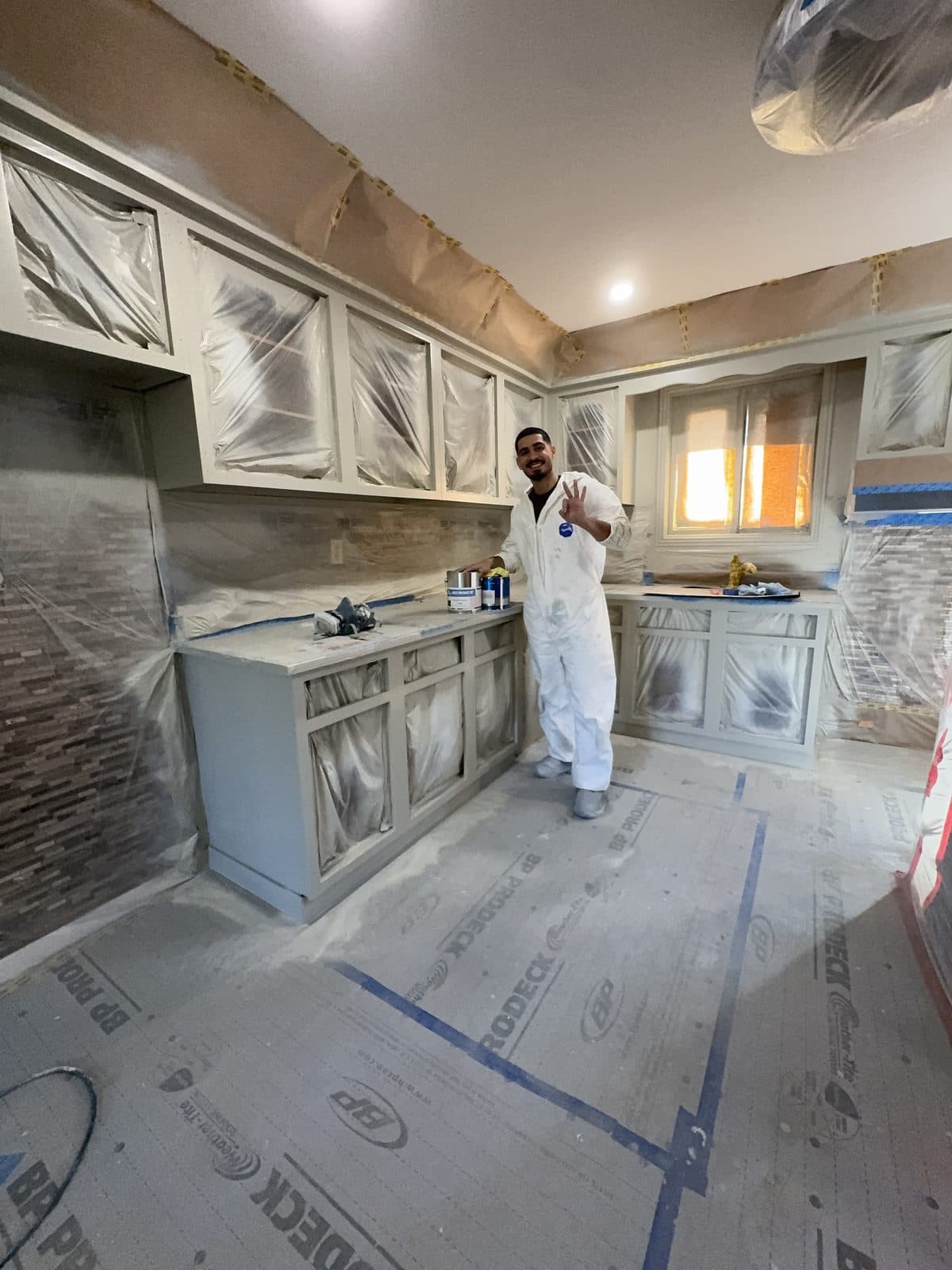
Full masking. Overspray goes everywhere air goes. Counters, floors, appliances, backsplash, the openings into the rest of the house — all of it gets papered and filmed before a single pass.
A controlled environment.Dust is the enemy. A speck of drywall dust landing in wet coating leaves a bump that's there forever. You also need stable temperature and airflow so the coating cures the way it's designed to.
The right tip and pressure.Cabinet coatings get sprayed through a fine-finish tip at a pressure matched to the product. Wrong tip means orange peel or dry spray — you've just recreated roller texture with a more expensive tool.
The right product.This is the biggest one. I spray an Italian Renner 2K water-based polyurethane industrial coating — a two-component product that chemically crosslinks as it cures, levels glass-flat, and dries into a far harder film than any latex. It's the same family of coating cabinet factories use. You can't buy it at the paint counter, and it's the main reason a professional finish feels like a factory door instead of a painted one.
That list is also why I split the job in two. Doors and drawer fronts come off and get sprayed in my shop, where I control dust, temperature, and drying racks completely. The cabinet boxes get sprayed in your home behind a sealed plastic barrier that keeps overspray and dust contained to the kitchen. Doors flat in a clean shop, boxes behind a sealed wall — that's how both halves of your kitchen end up with the same finish.
Where Spraying Fits in the Five Days
My standard kitchen runs five working days, and spraying is actually the short part:
- Day 1 — Protect the home, prep the kitchen, doors and drawer fronts come off and go to the shop
- Day 2 — Degrease everything, then dustless sanding
- Day 3 — Two coats of bonding primer
- Day 4 — Two coats of topcoat
- Day 5 — Reinstall, hardware, and a final walkthrough together
Days 3 and 4 are the spray days. Everything before them is what makes the spraying work — coating sprayed over kitchen grease or glossy old finish will fail no matter how good the product is. If you want the full process in detail, I've written a complete guide to cabinet painting in Windsor-Essex that walks through every day.
One local note: if you've got a 1960s or 70s oak kitchen — half of South Windsor does — open oak grain will telegraph through any coating, sprayed or brushed. I offer grain-filling as a specialty for people who want a completely smooth modern finish. Some clients prefer to keep a hint of grain texture; either way it's a decision we make before Day 1, not a surprise after.
When Brush and Roller Is Honestly Fine
I'd rather you trust me than hire me, so here's the honest list.
Inside the cabinets.Nobody's eyeballing the interior of your pot cupboard in raking light. If you're painting interiors, roll them and save the money.
A small bathroom vanity. One vanity, six doors, a room you redecorate every few years anyway? A careful brush-and-roll with proper degreasing and a real bonding primer is a perfectly sane weekend project.
A genuinely tight budget.If the choice is a careful DIY brush job or nothing, do the DIY job — just don't skip the degrease and the bonding primer. A well-prepped brushed kitchen beats a badly prepped sprayed one every time.
Character pieces.In some of the century homes in Walkerville and Sandwich Town, there are original built-ins where a hand-brushed look honestly suits the house. That's a legitimate style choice, not a compromise.
What I'm telling you is that brush-and-roll fails as a substitute for a sprayed kitchen, not that it has no place.
The "Sprayed Finish" Trap in Cheap Quotes
Every spring I see quotes floating around Windsor for $1,200–$1,500 promising a "sprayed look." Here's what that money usually buys: rolled-on wall latex, no degreasing, no bonding primer, two thin coats over kitchen grime. It looks passable for a few months. Then it starts peeling around the handles and under the sink — the two places hands and water touch every day — and the homeowner calls someone like me to strip it and start over. The cheap job becomes the most expensive option in the room.
If a quote claims spraying, ask two questions. How do you spray? What product, what prep, how many coats of what primer. Where do the doors go? If the answer is "we spray everything in your garage," ask how they control dust and how the doors dry. Vague answers are an answer.
And get it in writing. I give a flat-rate written quote on-site within the hour — no "it depends" pricing after the fact. I'm owner-operated and take one job at a time, so the person quoting your kitchen is the same person spraying it.
What Doing It Right Costs in 2026
Real numbers, because dancing around price wastes everybody's time. My kitchen cabinet painting pricing for 2026:
| Kitchen size | Doors & drawers | Price range |
|---|---|---|
| Small | 12–18 | $2,800–$3,400 |
| Standard | 22–28 | $3,500–$4,500 |
| Large | 30–38 | $4,500–$5,500 |
| Extra large | 40+ | $5,500–$7,500+ |
For context, replacing cabinets in Windsor-Essex commonly runs $15,000–$30,000+. A sprayed refinish on solid boxes gets you the factory-flat look for a fraction of that — which is exactly why the finish quality matters so much. If you're paying professional money, you should be able to run your hand across the door and feel the difference.
FAQ
Can I get a sprayed look with a foam roller and a leveling additive?
Closer, but no. Additives buy the paint a few extra seconds to flow out; they don't change what latex is. You'll reduce the stipple, not eliminate it, and on flat slab doors the lap lines will still show in side light.
Do you spray inside my house?
Only the cabinet boxes, and only behind a sealed plastic barrier that contains overspray and dust to the kitchen. Doors and drawer fronts are sprayed flat in my shop under controlled conditions — that's where the glass-flat finish comes from.
How long does the whole job take?
Five working days from protection to walkthrough. The actual spraying happens on days 3 and 4 — two coats of bonding primer, then two coats of topcoat — with prep before and reinstall after.
If you're weighing a sprayed kitchen against a brush-and-roll quote — or against doing it yourself — call or text me at 226-506-0993. I serve Windsor, Tecumseh, LaSalle, Lakeshore, Amherstburg, Essex, Kingsville, Leamington, and Chatham, and I'm happy to look at your doors and tell you straight which option actually makes sense for your kitchen, even if the answer isn't me.
Related reading: Complete Windsor-Essex Guide | DIY Cost Reality Check | Renner vs Benjamin Moore | Kitchen Cabinet Painting